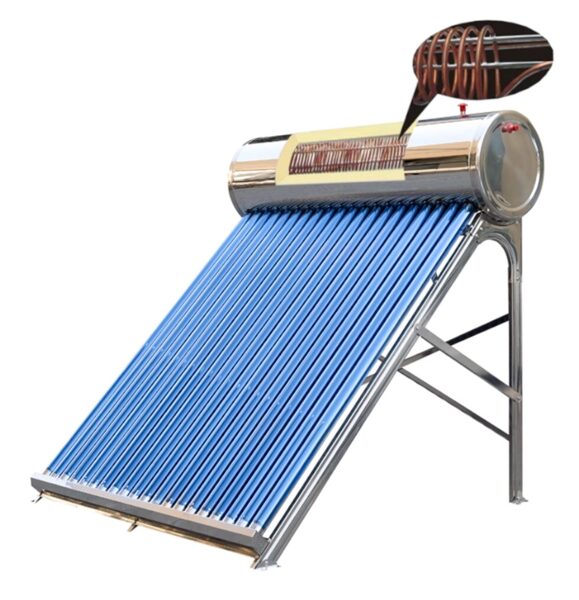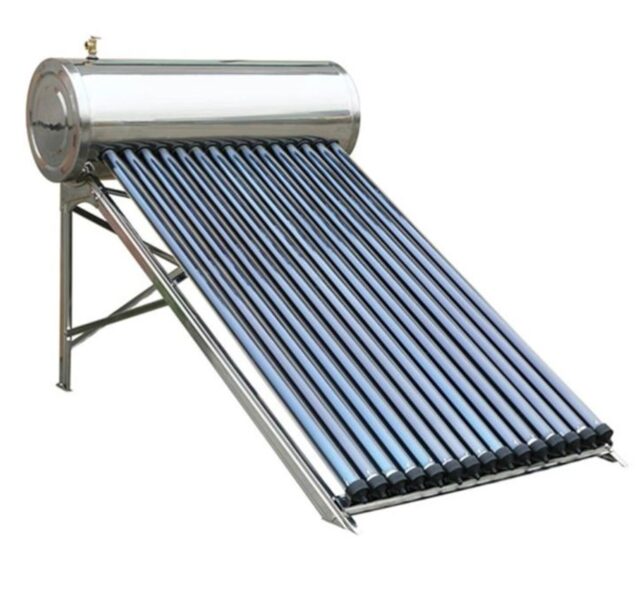


Vacuum solar collector SWS (20–100 flask system)
€645,00 – €3.875,00
A solar collector is a device for the preparation of hot water, which is intended to supplement an existing or to be installed hot water or heating system. On sunny days, the water can be heated to boiling point.
Equipment for operation at home is available it is necessary to install an accumulation tank with an additional heat exchanger / must purchase a separate storage tank that meets individual needs.
"Heat pipe" technology. The operation of the device is based on the technology of vacuum flasks with heat-pipes.
Volume. One solar collector with 20 vacuum flasks designed to be connected to a 150-200 liter storage water tank. 20 and 30 flask manifolds can be connected in series to larger water tanks depending on individual needs.
Easy to use. Suitable for installation both on the ground and on a horizontal or sloping roof. The water pressure is the same as in the water supply system. Thanks to the vacuum, the device can work efficiently even in winter.
The vacuum solar collector system consists of:
✓ vacuum solar collectors HSC-20 (20 flasks) or HSC-30 (30 flasks);
✓ controller + circulation pump SR881;
✓ expansion vessel;
✓ frame.
Note. Depending on the selected modification, the size (number of flasks) and color of the device may differ from the device shown in the picture.
Solar collector HSC-20 / HSC-30
(20-100 vacuum flask system)
PRINCIPLE OF OPERATION
The surface of the vacuum glass flasks absorbs more than 93% of the energy contained in the sun's rays. Solar energy is converted into heat, and with the help of a vacuum, the heat is turned inside the vacuum glass flask.
The energy turned on in the vacuum flasks is concentrated in copper heat-pipes inside the flasks. The liquid inside the copper heat-pipes heats up to 200 °C and rises in the form of steam to the head of the heat-pipe condenser, which effectively transfers the heat through indirect contact (through the copper pocket) to the heat exchanger above, through which a non-freezing liquid circulates in a separate cycle (the liquids inside the heat pipe and in the heat exchanger do not mix with each other). Then, after giving up heat in the heat exchanger, the cooled vapor turns into a liquid in the heat pipe and returns to the bottom of the heat pipe to start the cycle again.
A non-freezing liquid circulates in the heat exchanger, which transfers the heat to a storage tank installed in the house. If there is enough sunlight, the non-freezing liquid circulating in the heat exchanger can be heated to 100-160 °C.

1. Heat exchanger.
2. Copper heat pipe with liquid.
3. Vacuum glass flask.
4. Insulation layer.
5. The heated steam rises to the condenser head.
6. The cooled vapor turns into a liquid and the cycle repeats itself.
INSTALLATION
The design of the solar collector frame is universal, so it can be installed both on the ground and on the roof (horizontal or inclined). It can also be mounted on a vertical surface (wall) using an additional frame. The height at which the device is installed does not affect the operation.
In order to maintain a high efficiency of the solar collector, the unit should be placed where the shortest possible connecting pipes can be used. Pipes through which heat energy is transported to the storage tank in the house must be well insulated. We recommend the use of flexible corrugated stainless steel pipes with an insulating jacket. Copper or other metal pipes with a thermally insulated jacket are also suitable. Ordinary multilayer pipes are not suitable, because a high temperature is reached (the heat carrier can heat up to 100–160 °C).
ADDITION
The solar collector does not have a built-in water tank, so all the heat produced must be transferred to a remote water tank. Heat transport is carried out using circulation with an electric pump.
The solar collector can be connected and used in different ways, but most often it is connected to a storage tank / boiler with a heat exchanger, for circulation a workstation consisting of an electronic controller and an integrated circulation pump is used. The entire system is filled with a non-freezing liquid (technical liquid) so that the equipment can be used in winter. The technical fluid that transfers heat and the water in the storage tank / boiler do not mix with each other.
The controller receives temperature readings from two sensors mounted in the water tank (T1) and the solar collector (T2). When the solar collector produces more heat than the water temperature in the tank / boiler (T2 > T1), the controller turns on the circulation pump and starts the heat transfer from the solar collector to the water tank. Conversely, the circulation pump is switched off as soon as the collector starts producing lower heat than what is in the water tank (T2 < T1), the heat it has accumulated is not returned and remains in the water tank. Below is a sample addition.

1. Temperature sensor T1.
2. Temperature sensor T2.
3. Solar collector.
4. Work station (controller + circulation pump).
5. Expansion vessel.
6. Cold water.
7. Hot water
USE IN WINTER
The solar collector also works in winter. The unit does not have an external water tank that can freeze, so it can work all year round, but provided that the heat exchanger system is filled with non-freezing liquid, while the pipes through which the heat is transferred are well insulated.